AI search is no longer an experiment. For many websites, it is already shaping how visibility, trust, and traffic are earned.
In 2026, tools like ChatGPT, Gemini, and Perplexity influence how people discover brands just as much as traditional search results. Some businesses will adapt quietly and protect their visibility. Others will notice traffic slipping without a clear explanation.
This guide explains how AI search actually works, what signals matter now, and how to optimise for discovery in a world where rankings alone are no longer enough.
The AI Search Landscape in 2026 (At a Glance)
Before getting into tactics, it helps to understand the scale of the shift.
This article builds on our earlier analysis of AI adoption and market movement in 2025, where we broke down how different assistants gained traction and what that meant for discovery heading into this year.
Read: AI App Winners of 2025 and Market Share Trends for 2026
How AI Search Really Works
Most people assume AI search is powered by a single system. It isn’t.
There are two distinct layers involved when an AI tool answers a query, and visibility depends on both.
The language model layer
Large language models are trained on vast amounts of historical data. That data is often months or even a year old.
At this layer, visibility works like a probability signal. Brands that appear frequently across trusted websites, publications, reviews, and discussions are more likely to be mentioned.
This is where AI-focused authority building becomes critical. If you want a deeper look at how this differs from traditional optimisation, we’ve covered it in more detail in our AI SEO guide:
The real-time search layer
When a question requires current information, AI tools run live searches behind the scenes. In most cases, these rely on Google’s index.
The AI then pulls from high-ranking, clearly written pages and synthesises an answer.
In practice, AI visibility depends on both training data presence and real-time search performance.
What to Track in 2026 (and What to Stop Obsessing Over)
Traditional keyword rankings still matter, but they no longer tell the full story. AI search does not present ten blue links, so position tracking alone is incomplete.
Instead, focus on signals that reflect how people actually use AI tools.
Many of the fundamentals here still sit within strong technical and strategic SEO foundations. If your tracking and reporting are inconsistent, this is where an experienced SEO consultancy adds real value:
Track long, conversational queries
AI prompts tend to be long and specific. Queries with seven or more words closely mirror how users phrase questions to AI tools.
In Google Search Console, filter queries by length. These searches often reveal early AI-driven discovery patterns.
Monitor brand mentions inside AI answers
Once a month, create fresh, unpersonalised AI accounts. Run realistic commercial prompts such as:
“Best [your product] for [use case] in 2026”
Track two simple things:
- Are you mentioned, yes or no
- Where you appear in the response
Separate AI traffic in analytics
In GA4, set up distinct filters for referrals from ChatGPT, Perplexity, Claude, and other AI platforms.
Treat AI traffic as its own discovery channel. This is often where change shows up first.
Build Content That AI Can Retrieve
When AI tools need fresh information, they search the web in much the same way a user would.
You can observe this behaviour using Chrome DevTools by watching which queries AI tools run behind the scenes.
Once you know those queries, optimise for them.
This is where traditional SEO execution still plays a critical role. Pages that rank well for searches AI systems frequently perform are far more likely to be cited.
For businesses competing in high-density regions, particularly competitive cities, this overlap between traditional and AI visibility becomes even more important. We see this clearly in markets like London SEO, where search competition is already intense:
Treat Brand Mentions as the New Backlinks
In AI search, brand mentions often matter more than links alone.
The more often your brand appears in relevant, trusted contexts, the more likely it is to surface in AI-generated answers.
This shift is one of the clearest differences between legacy SEO and AI-era optimisation, and it’s a core focus of modern AI SEO strategies:
Focus your effort where mentions influence trust.
For local businesses, prioritise your Google Business Profile, followed by platforms like Yelp, Angie, and Thumbtack.
For ecommerce brands, combine strong on-site reviews with trusted marketplaces such as Amazon or Etsy.
For SaaS companies, invest in platforms like G2 and Capterra, alongside industry publications and community discussions.
Automate the Work That Slows You Down
The advantage in 2026 will not come from collecting more data. It will come from asking better questions of the data you already have.
If you are comfortable with data analysis, tools like Python and pandas can help surface insights from Search Console and analytics exports.
For non-technical teams, GPT for Sheets can handle categorisation, cleanup, and analysis directly in Google Sheets.
The tools matter less than intent. Data is cheap. Insight is not.
Create Content AI Cannot Replace
Generic informational content is losing value. AI can answer many of those questions instantly.
What AI cannot replicate is lived experience.
Content that performs best in AI search is rooted in real work:
- Case studies with real metrics
- Experiments and testing results
- Process documentation
- Clear opinions based on firsthand experience
This type of content aligns strongly with experience-led optimisation approaches we apply across both SEO consultancy and AI SEO engagements.
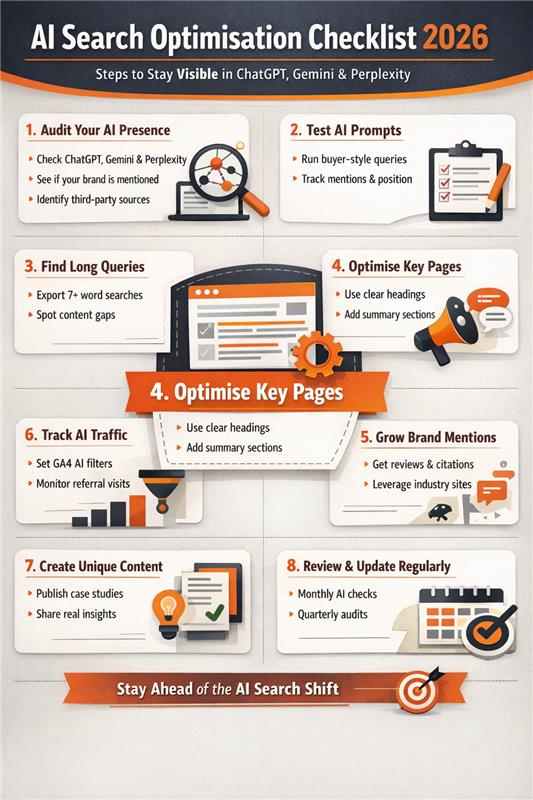
Download: AI Search Optimisation Action Checklist for 2026
To make this practical, we’ve included a downloadable checklist that turns everything above into clear actions.
Download the AI Search Optimisation Action Checklist for 2026
Use it as a quarterly audit or a working framework for improving AI visibility across ChatGPT, Gemini, and Perplexity.
FAQs
Yes, but they no longer tell the full story. Rankings influence the real‑time search layer, but AI tools also rely on brand authority, mentions, and training‑data presence.
Track AI‑generated traffic by creating separate GA4 filters for referrals from ChatGPT, Perplexity, Claude, and other AI platforms. Treat AI traffic as its own discovery channel.
Increase brand mentions by strengthening your presence across trusted platforms: Google Business Profile, Yelp, Amazon, G2, Capterra, industry publications, and community discussions.
Content rooted in real experience performs best — including case studies, experiments, process documentation, and clear opinions based on firsthand work.
To optimise for Featured Snippets, use short, direct definitions, bullet lists, and answer‑first formatting. Place the clearest answer within the first 1–2 sentences of each section.
The biggest mistake is treating AI search like a traditional algorithm update. It’s a fundamental shift in how visibility is earned, and waiting too long to adapt leads to silent traffic decline.
What Comes Next
It’s pretty clear; the biggest mistake businesses can make in 2026 is assuming this is just another algorithm change.
It isn’t.
AI search changes who gets seen before a click ever happens. We are already seeing brands lose visibility without doing anything “wrong” by traditional standards. At the same time, others are quietly gaining ground by showing up consistently inside AI answers.
What has become clear is that visibility now depends on trust, clarity, and presence across the wider web, not just performance in a single channel.
The businesses that do well in 2026 will be the ones that treat AI as an environment, not a tool.
Those who wait will not notice the shift all at once. They will simply wonder where their traffic went.
The window to adapt is still open, but it will not stay that way for long.

