Artificial intelligence adoption accelerated rapidly in 2025. AI apps moved from optional tools to everyday utilities used for work, research, and decision making.
For the first time, the AI market became competitive at scale. While ChatGPT remained the most widely used assistant, rival platforms gained ground by embedding AI directly into operating systems, browsers, and productivity software.
This article examines which AI apps gained the most market share in 2025, which platforms lost momentum, and what these trends indicate for AI usage and business strategy in 2026.
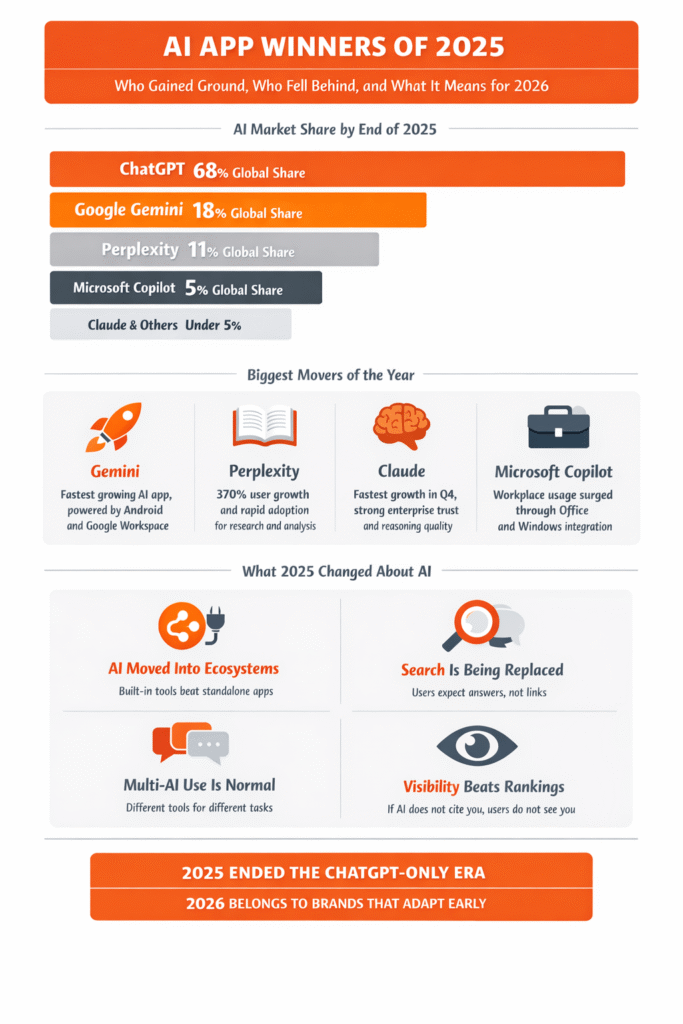
Key Takeaways from the AI App Market in 2025
ChatGPT remained the largest AI app in 2025, with approximately 68 percent of global generative AI traffic by the end of the year, despite increased competition.
Google Gemini was the fastest growing AI app in 2025, tripling its market share through Android integration, Workspace tools, and built-in distribution.
ChatGPT lost market share due to increased competition from AI platforms embedded directly into operating systems, browsers, and productivity software.
AI answer engines are increasingly replacing traditional search behaviour by providing direct responses instead of lists of links.
Businesses should focus on being cited as trusted sources within AI systems, improving content accuracy, and optimising for multiple AI platforms rather than search rankings alone.
ChatGPT Market Share in 2025
At the start of 2025, ChatGPT controlled roughly 87 percent of global generative AI traffic. By December, that figure had fallen to around 68 percent, even though total usage continued to increase.
ChatGPT remains the most widely used AI assistant worldwide. It continues to lead in several areas:
- The largest global active user base
- A strong paid subscription model
- High benchmark performance following the release of GPT-5.2
The decline in market share was not caused by a drop in quality. It was driven by distribution. ChatGPT operates primarily as a standalone product, while competitors placed AI directly inside devices and software people already use every day.
2025 marked the end of ChatGPT’s uncontested dominance, not its relevance.
Why Google Gemini Grew Faster Than Any AI App in 2025
No AI platform grew faster in 2025 than Google Gemini.
Key growth indicators include:
- Global market share rising from 5.4 percent to 18.2 percent
- US market share reaching 13.4 percent by year end
- Monthly users increasing from roughly 450 million to 650 million in a single quarter
Gemini’s growth was driven by three structural advantages.
First, default placement across Android devices meant users did not need to download a separate app.
Second, deep integration across Google Workspace brought AI directly into Gmail, Docs, Sheets, and Slides.
Third, strong image generation performance helped differentiate the platform. Gemini’s Nano Banana Pro model gained attention for producing images with clear, readable text, an area where many competitors still struggle.
By the end of 2025, Gemini was firmly established as the second most used AI assistant globally.
How Perplexity Became a Leading AI Research Tool
Perplexity recorded one of the strongest growth curves of any AI platform in 2025, particularly among students, analysts, and professionals.
Key performance indicators included:
- A peak market share of 14.1 percent
- Stabilisation between 6 and 11 percent by year end
- More than 370 percent year over year user growth
Perplexity also expanded into enterprise use cases, including partnerships such as a Perplexity powered AI phone released with T-Mobile.
By focusing on citations, transparency, and structured answers, Perplexity positioned itself as a credible alternative to traditional search engines rather than a general purpose chatbot.
Microsoft Copilot Usage Trends in 2025
Microsoft Copilot delivered steady but uneven growth throughout the year.
In the United States, Copilot reached approximately 14 percent market share. Globally, adoption remained closer to 3 to 5 percent.
Engagement data tells a stronger story. Weekly Copilot sessions increased by more than 90 percent during 2025.
Copilot’s strength lies in its integration across Windows, Office, Teams, Outlook, and Edge. For many professionals, it has become a routine workplace tool rather than a destination app.
Claude AI Growth and Enterprise Adoption
Claude, developed by Anthropic, remained smaller than most competitors but recorded the fastest growth rate in late 2025.
Notable trends included:
- Market share growth from 0.9 percent to 3.8 percent
- The fastest growth of any major AI assistant in the fourth quarter
Claude gained traction by prioritising reasoning quality, safety controls, and predictable outputs. These qualities appealed to enterprise users seeking reliability rather than experimentation.
DeepSeek and Grok: Emerging AI Disruptors
Two newer platforms signalled future disruption.
DeepSeek briefly reached 4 to 5 percent market share before stabilising closer to 1.5 percent. Its low cost open models disrupted pricing expectations across the AI industry and contributed to sharp market reactions affecting Nvidia.
Grok, developed by xAI, climbed to nearly 3 percent global market share, with smaller but growing traction in the United States.
Both platforms demonstrated early momentum that may accelerate further in 2026.
What the 2025 AI App Trends Mean for 2026
Several patterns emerged clearly from 2025 data.
AI platforms embedded into existing ecosystems outperformed standalone apps. Users adopted AI fastest when it appeared inside tools they already used.
AI answer engines continued to replace traditional search behaviour. More users now expect direct answers rather than lists of links.
Multi AI usage became the norm. Many people now rely on different assistants for different tasks, including work, research, and everyday questions.
As AI assistants increasingly decide which sources are cited or summarised, businesses must move beyond traditional rankings and focus on AI SEO strategies that improve visibility across generative search, answer engines, and embedded AI systems.
Summary: How the AI App Market Is Shaping 2026
By the end of 2025, the AI app market had shifted from single platform dominance to multi tool usage. Growth favoured AI systems embedded into existing ecosystems, while users increasingly relied on different assistants for different needs. In 2026, business visibility will depend less on traditional search rankings and more on whether content is trusted, cited, and surfaced by AI systems.

